

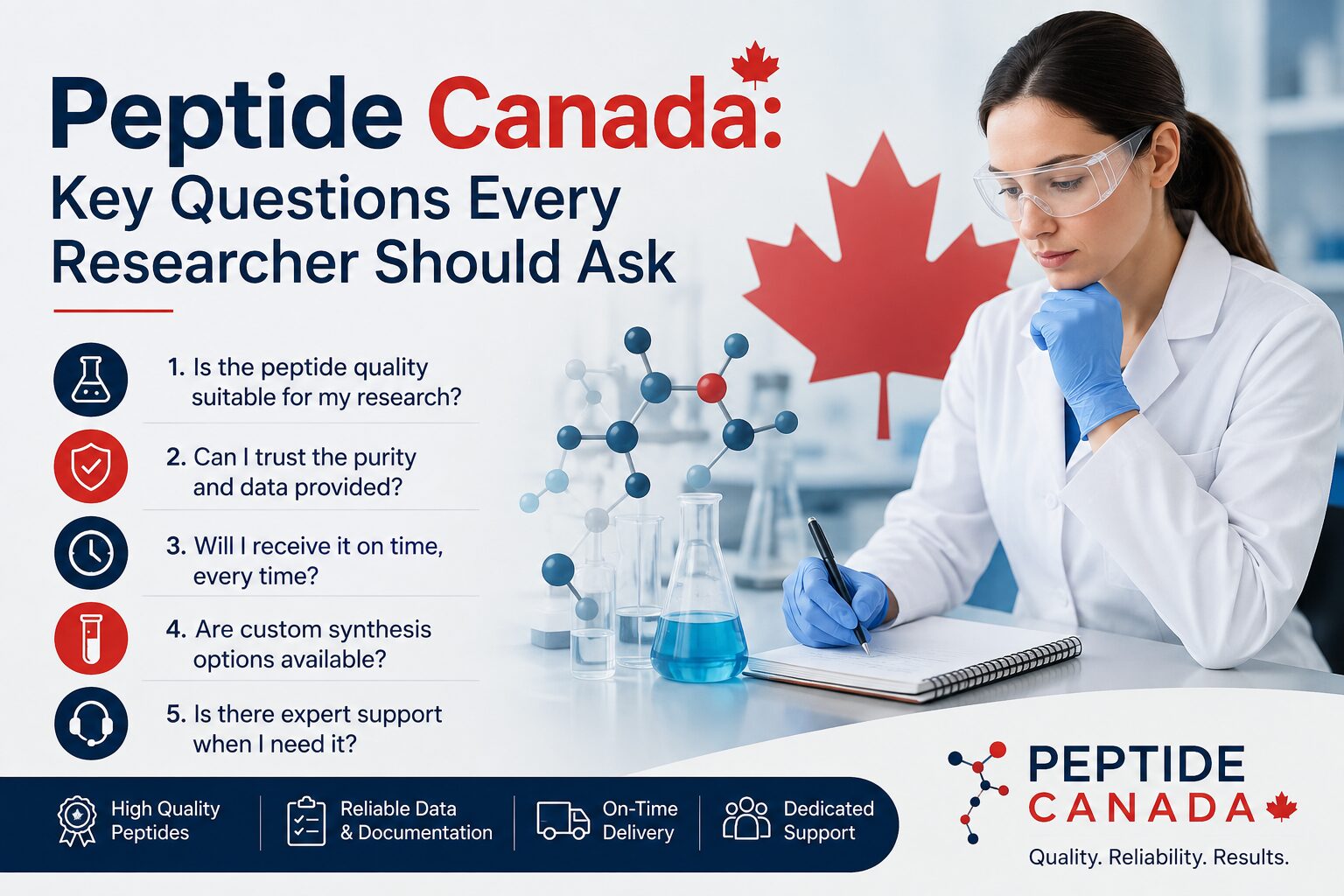
Peptide research has grown considerably across Canadian laboratories, academic institutions, and independent science communities. As interest in bioactive compounds continues to expand, so does the need for accurate, reliable information about sourcing, quality standards, and practical application. This article addresses the most common questions researchers ask when navigating the peptide Canada landscape—presented in a clear, straightforward format.
In This Article
- What Exactly Are Peptides, and Why Do Researchers Use Them?
- How Is Peptide Purity Measured, and Why Does It Matter?
- What Should Canadian Researchers Look for When Choosing a Supplier?
- Third-party or in-house verification — Does the supplier provide documented proof of purity analysis for each product?
- Synthesis methodology — Are both solid-phase and solution-phase synthesis techniques used to ensure structural accuracy?
- Storage and handling standards — Are products stored under appropriate conditions to maintain stability during transit?
- Regulatory transparency — Does the supplier clearly state that products are intended for laboratory research purposes only?
- Are There Specific Peptides Commonly Used in Canadian Research Institutions?
- How Does Domestic Canadian Sourcing Benefit Research Programs?
- What Are the Proper Storage Conditions for Research Peptides?
- Final Thoughts on Sourcing Peptides in Canada
What Exactly Are Peptides, and Why Do Researchers Use Them?
Peptides are short chains of amino acids linked by peptide bonds. They occur naturally in the body and play essential roles in biological signaling, cellular communication, and metabolic regulation. In a research context, synthetic peptides allow scientists to study these processes in controlled settings, examine potential therapeutic targets, and better understand how specific sequences interact with biological systems.
Their versatility across multiple research categories—including tissue repair, metabolic function, cognitive studies, and recovery mechanisms—makes them one of the more sought-after compounds in modern laboratory work.
How Is Peptide Purity Measured, and Why Does It Matter?
Purity refers to how much of a given compound in a sample is actually the intended peptide, free from contaminants or degradation byproducts. In research settings, purity directly affects the reliability of experimental results. A lower-purity compound introduces variables that can skew data and compromise study integrity.
The two most widely accepted analytical methods for verifying peptide purity are High-Performance Liquid Chromatography (HPLC) and Mass Spectrometry (MS). HPLC separates compound components to quantify purity, while MS confirms the molecular identity of the peptide by measuring mass-to-charge ratios. Reputable Canadian suppliers use both methods to validate every batch before shipment.
What Should Canadian Researchers Look for When Choosing a Supplier?
Selecting a peptide supplier involves more than price comparison. Researchers should evaluate several key factors:
Third-party or in-house verification — Does the supplier provide documented proof of purity analysis for each product?
Synthesis methodology — Are both solid-phase and solution-phase synthesis techniques used to ensure structural accuracy?
Storage and handling standards — Are products stored under appropriate conditions to maintain stability during transit?
Regulatory transparency — Does the supplier clearly state that products are intended for laboratory research purposes only?
A supplier with rigorous quality control at every stage—from synthesis to packaging—is the foundation of dependable research outcomes.
Are There Specific Peptides Commonly Used in Canadian Research Institutions?
Canadian researchers work across a broad spectrum of peptide compounds depending on their field. Some of the most frequently studied include:
BPC-157 — studied for its role in tissue repair and gastrointestinal research
TB-500 — examined for cellular migration and recovery-related mechanisms
CJC-1295 — used in growth hormone secretagogue studies
Ipamorelin — another growth hormone-releasing peptide studied for its selective action
Semax and Selank — investigated within the context of cognitive and neurological research
GHK-Cu — a copper peptide studied for its involvement in skin repair and anti-aging biology
Each compound serves a distinct research purpose, and sourcing the correct peptide with verified purity is critical to producing credible results.
How Does Domestic Canadian Sourcing Benefit Research Programs?
Sourcing peptides from within Canada offers several practical advantages for research programs. Domestic shipping timelines are generally shorter and more predictable, reducing the risk of temperature-sensitive compounds degrading in transit. There are also fewer customs complications compared to international imports, which can delay shipments or introduce additional documentation requirements. Additionally, working with a Canadian supplier allows researchers to communicate more easily regarding technical specifications, batch documentation, and compliance requirements.
What Are the Proper Storage Conditions for Research Peptides?
Most lyophilized (freeze-dried) peptides should be stored in a cool, dry environment—typically at or below -20°C for long-term storage. Once reconstituted with bacteriostatic water, the solution is generally stable under refrigeration for a limited window. Researchers should always consult the product-specific documentation provided by the supplier and avoid repeated freeze-thaw cycles, which can degrade peptide integrity over time.
Proper storage is not an afterthought—it is a core part of maintaining research quality from the moment a product is received.
Final Thoughts on Sourcing Peptides in Canada
For researchers committed to producing sound, reproducible science, the quality of their source compounds is non-negotiable. Choosing a Canadian supplier with verified purity standards, transparent analytical documentation, and a clear commitment to research-use integrity ensures that the peptides entering your laboratory meet the standards your work demands. The Peptide Labs (thepeptidelabs.ca) is a Canadian-based supplier offering research-grade peptides verified through HPLC and Mass Spectrometry, with purity exceeding 99% across their catalog.